
Raven Studios is building something the Pacific Northwest didn’t know it needed
An aerial and pole studio in Seattle’s SODO neighborhood didn’t just add square footage to the local aerial arts scene — it’s making a deliberate bet on community, accessibility, and what it means to share a practice.
There’s a particular kind of courage involved in opening a large aerial studio. The rigging alone is a commitment. The square footage, the equipment, the instructor pipeline — these aren’t things you build halfway. When Raven Studios opened its doors in Seattle’s SODO neighborhood in 2020, it did so at a scale that signaled it was meant to last.
The studio occupies more than 4,000 square feet across five distinct rooms, each designed with a specific purpose in mind. It’s the kind of space that takes aerial arts seriously as a discipline — not as a novelty offering tucked into the corner of a fitness gym, but as the whole point.
“The phrase ‘Your aerial journey starts here’ sounds like marketing copy until you walk into a studio designed around the premise that everyone, at every level, actually belongs there.”
A PHILOSOPHY OF SHARING
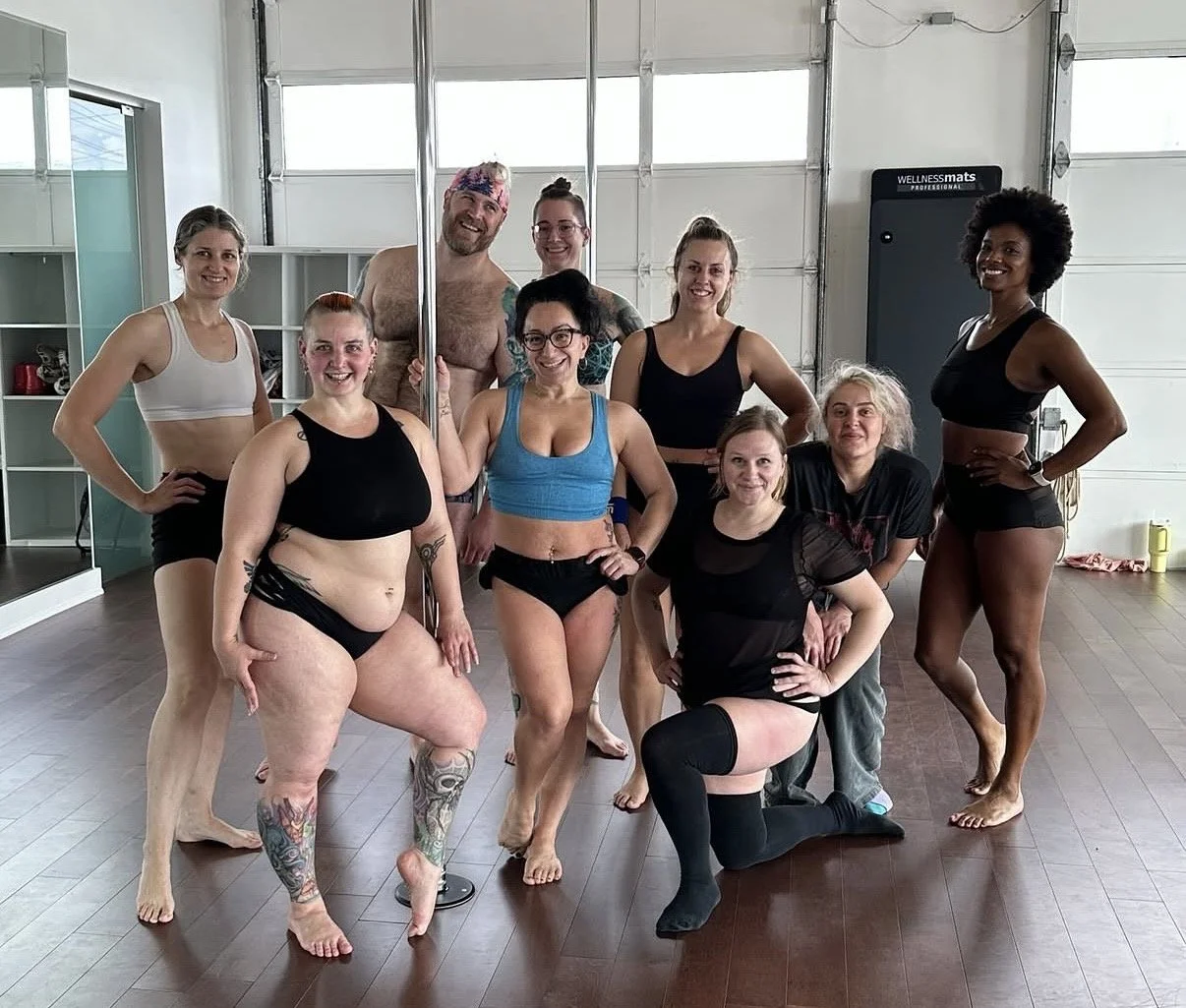
What stands out most about Raven’s model isn’t the equipment — it’s the thinking behind how students use it together. In an industry where apparatus-per-student ratios can quietly become a status marker, Raven has leaned into shared apparatus as both a practical and philosophical choice. Most group classes pair students on a single pole or aerial point, which keeps pricing accessible and — perhaps more importantly — creates the side-by-side learning dynamic that builds real community.
The studio is explicit about this: shared apparatus isn’t a compromise, it’s a feature. It slows people down in a good way, encourages spotting and peer learning, and produces the kind of training relationships that keep students coming back for years rather than months.
For studio owners watching from elsewhere, it’s a worthwhile model to consider. Accessibility and culture aren’t at odds with running a serious training facility — Raven’s programming covers the full skill arc from complete beginner to competition-level work, all under the same roof and the same ethos.
STRUCTURED FOR EVERY LEVEL
Raven’s curriculum spans pole, lyra, aerial hammock, aerial silks, and aerial rope, with an enrichment track covering flexibility and handstands. The progressions are clearly defined — beginners start in designated Level 1 classes that run every single day of the week, removing one of the common friction points that causes new students to drop off before they find their footing. Advanced students work toward skills like competition-regulation pole work, with a private studio room — Haven — available for focused individual training and rentals.
The Tower, a dedicated aerial-only space for hammock and lyra, keeps ground-based and aerial training from competing for the same ceiling. It’s a detail that reflects experience — anyone who has managed a mixed-use aerial space knows how much scheduling tension that one decision eliminates.
Beginner Level 1 classes run every single day — removing one of the most common friction points that causes new students to drop off.
WHAT IT SIGNALS FOR THE SEATTLE SCENE
SODO isn’t the obvious neighborhood for a pole and aerial studio. It’s industrial, transit-adjacent, and parking-forward — which, it turns out, works well for a destination fitness business where people are willing to travel specifically for the training. The free parking lot nearby and street parking on 1st Ave S reinforce that this is a studio thinking practically about removing barriers to entry.
With over 80 classes and open gym sessions per week, Raven is operating at a volume that changes the texture of aerial arts in the region. More weekly touchpoints means faster student development, more consistent community formation, and a studio that starts to function as an anchor institution rather than just a class venue.
Five years is long enough to know whether a studio has real roots. Raven has them. The programming depth, the community philosophy, the deliberate approach to accessibility — these aren't the marks of a studio still figuring itself out. They're the marks of one that already has.